• Expanded media coverage, endorsement deals and national exposure are reshaping how WNBA players earn — but the biggest rewards still belong to a select group of stars.
    by John Brickley

    For years, the WNBA’s financial reality forced many of its stars to pack their bags as soon as the season ended. Players boarded flights to Russia, Turkey and China, chasing the salaries the league at home could not yet provide.

    Now, a new milestone suggests the economics of women’s basketball may finally be shifting.

    For the first time, select WNBA players are earning more than $1 million annually through a combination of league salary, endorsements, media exposure and brand partnerships. The breakthrough reflects rising investment in the league — but also the growing influence of storytelling, broadcast visibility and player branding in today’s sports economics.

    The milestone also raises a larger question: does the WNBA’s financial surge represent sustainable growth for the league as a whole, or does the new wealth remain concentrated among a small group of marketable stars?

    Broadcasters, analysts and producers across the league say visibility — and the stories built around players — plays a central role in determining who reaches that financial threshold.


    How Million-Dollar Earnings Are Built

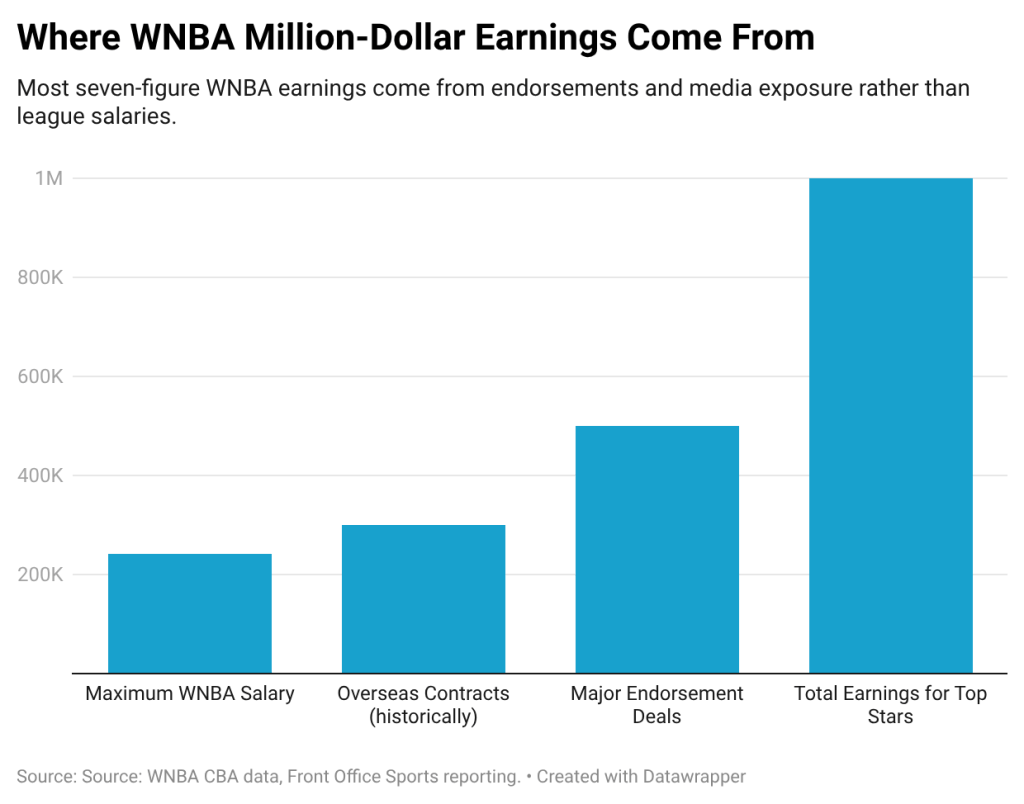
    Unlike many men’s professional leagues, seven-figure income in the WNBA rarely comes from salary alone.

    The league’s current maximum salary remains under $250,000 per season. Reporting from Front Office Sports shows that endorsement deals and corporate partnerships account for the majority of income for players who reach the million-dollar mark.

    Edona Thaqi, a WNBA commentator for USA Network, says media narratives often determine which players break into mainstream visibility.

    “Media narratives play a major role in determining which WNBA players gain national traction,” Thaqi said. “Strong on-court performance is essential, but storytelling — rivalries, personality, cultural impact and social presence — often determines who breaks into mainstream visibility.”

    Players who connect with audiences beyond basketball frequently see the largest financial rewards.

    “In today’s media environment, earning power is closely tied to how well a player’s story connects beyond basketball audiences,” Thaqi said.


    The Power of the Player Story

    For broadcasters calling games, storytelling has become central to how fans connect with players.

    Brendan Glasheen, the voice of the Connecticut Sun and a broadcaster for the women’s basketball venture Unrivaled, says modern sports fandom often revolves around individual stars.

    “We are in an era now where sports fandom extends to individual greatness,” Glasheen said. “You might watch a team because you are a fan of an individual. In women’s and men’s basketball, star players have large brands and fans gravitate to them.”

    Broadcasts often help build those narratives.

    “When done right, sports broadcast provides a platform to boost or amplify a player’s brand,” Glasheen said. “The game still matters — but sometimes the game is the roadmap and the star player is the vehicle.”

    Fans increasingly follow players across teams and platforms.

    “Fans want to relate to their favorite players,” Glasheen said. “Many young players are making way more off the court. Intertwine the two — it’s part of the story.”


    Broadcast Visibility and Market Value

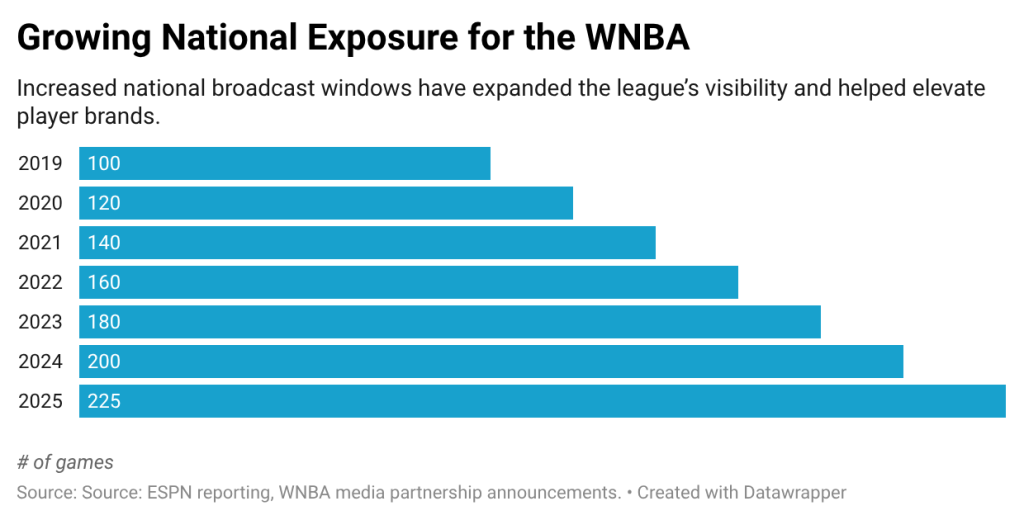
    National television exposure plays a major role in determining which players gain endorsement opportunities.

    Andy Bock, a producer for the Connecticut Sun and national WNBA broadcasts on ION, says production decisions often center around athletes who drive ratings.

    “Broadcast visibility plus aggressive marketing of a star player are the two biggest factors,” Bock said.

    The approach mirrors how networks promote NBA games.

    “You never see an NBA game promo that doesn’t feature stars like LeBron, Steph, Luka or Jokic if their team is playing,” Bock said.

    Highlight packages and broadcast storytelling frequently center on the WNBA’s biggest names.

    “Highlighting those players in broadcast opens and in-game packages is how production can directly affect market value,” Bock said.

    The reason is simple.

    “Stars drive ratings,” Bock said. “Ratings equal ad revenue and affiliate fees. That’s what keeps networks profitable.”


    A League Still Defined by Star Power

    The WNBA’s financial structure increasingly mirrors other professional sports.

    A small group of elite athletes often dominates endorsement revenue.

    “It’s all about the stars,” Bock said. “Ancillary players benefit slightly — like a rising tide lifting all boats — but the biggest revenue always follows the most marketable athletes.”

    Glasheen says that reality reflects the league’s size.

    “Many fans that follow the WNBA are fans of specific players because the league is still very young and very small,” Glasheen said.

    Expansion could change that dynamic.

    In 2026, the WNBA will add two new teams, bringing the league total to 15 franchises and roughly 165-180 players.

    “With a smaller league, players who go pro can become immediate superstars with major impact,” Glasheen said.

    But storytelling still must follow the game itself.

    “Capture those player stories — only if the game fits,” Glasheen said. “The scoreboard still matters over the course of a 44-game season.”


    Labor Conversations and the Next CBA

    The WNBA’s financial growth has also sparked conversations about player compensation.

    According to ESPN, stars Breanna Stewart and Kelsey Plum recently raised concerns about how negotiations for the league’s next collective bargaining agreement are being handled.

    As television deals expand and sponsorship investment grows, players want a larger share of the league’s increasing revenue.

    Future negotiations could determine whether the league’s economic growth translates into higher salaries across rosters.


    A Turning Point for Women’ds Basketball

    The emergence of million-dollar WNBA players marks a milestone that once seemed unlikely.

    Corporate sponsorships continue to grow. National television exposure has expanded. Social media allows players to build global audiences.

    The league’s financial ecosystem is evolving quickly.

    For now, the rise of seven-figure earners signals a new era of opportunity for women’s basketball.

    Whether that financial momentum reaches every roster spot may define the WNBA’s next chapter.
  • By John Brickley

    The red light flicked on inside the campus broadcast booth, and Beckett Calkins’ voice cut through the gym with professional calm as he called the opening tip. Across the sports media industry, layoffs and consolidation continue to shrink traditional career paths, leaving student broadcasters like Calkins preparing for a future that looks far less certain than the one they once imagined.

    From the outside, college sports broadcasting looks unchanged. The play-by-play cadence rises on a fast break. The color analyst fills the silence. The producer counts down to commercial. Inside the booth, however, student broadcasters now carry a sharper awareness of risk as they train for an industry that no longer guarantees stability.

    Major sports media outlets have reduced staff, consolidated coverage, and shifted resources in ways that signal long-term change. While public attention often focuses on veteran journalists losing jobs, college students preparing to enter the profession feel the ripple effects just as strongly. They continue to chase the same dream — calling games, telling stories and covering sports — but they do so knowing talent alone may no longer be enough.

    “I still love calling games,” said Calkins, a sports journalism graduate student at Quinnipiac University. “But now I don’t think just being good on the mic is enough. You have to do everything.”

    For many students, “everything” now includes shooting and editing video, running social media accounts, producing live streams, creating graphics and building personal brands alongside academic work. Students describe an unspoken pressure to become multi-skilled early, not as a résumé booster, but as a survival strategy in a tightening job market.

    That reality resonates with fellow graduate student Benjamin Rickevicius, who balances on-air work with production responsibilities. Rickevicius said recent industry layoffs forced him to rethink how he defines success in sports media.

    “It used to be about landing a full-time job with a network or a team,” Rickevicius said. “Now it’s more about staying in the industry at all, even if that means freelancing, bouncing between roles or working contract to contract.”

    Faculty members who oversee sports media programs say they see this shift clearly. Nick Pietruszkiewicz, an assistant professor of journalism at Quinnipiac, director of sports communications and co-director of sports studies, said today’s students arrive with a mix of passion and realism shaped by the instability they witness across the industry.

    “They’re more aware than students were 10 years ago,” Pietruszkiewicz said. “They understand the industry doesn’t owe them anything, and that changes how they approach their education.”

    Pietruszkiewicz said the program has adjusted its curriculum to reflect that reality. Instead of training students for narrowly defined on-air roles, the program emphasizes versatility. Students learn how to report, edit, produce and distribute content across platforms, often within the same course.

    “We’re not telling students to stop dreaming,” Pietruszkiewicz said. “We’re telling them to build skill sets that give them more ways to stay in the game.”

    That message creates both opportunity and pressure. Some students view the expanding skill requirements as empowering. Others worry the industry expects too much from young broadcasters before offering job security.

    “There’s a feeling that you always have to be working,” Calkins said. “If you’re not calling a game, you’re editing. If you’re not editing, you’re posting. If you stop, someone else is ready to take your place.”

    That constant motion has changed how students approach college broadcasts. Several said they no longer view games as practice, but as professional showcases. They seek feedback earlier, take criticism seriously and build portfolios with urgency.

    “I don’t look at this as a class anymore,” Rickevicius said. “Every game feels like an audition.”

    Despite the uncertainty, optimism still fills broadcast booths and production rooms. Students continue to arrive early, stay late and invest emotionally in games that draw small audiences. Faculty members say that dedication remains the most encouraging sign.

    “The platforms may change, but storytelling still matters,” Pietruszkiewicz said. “Students who understand accuracy, preparation and clarity have skills that travel.”

    For today’s college sports broadcasters, “making it” no longer means a single destination or job title. It means adaptability, resilience and a willingness to evolve alongside the industry.

    Back in the booth, the final buzzer sounds and the broadcast signs off. The students pack up their equipment and head back across campus, already thinking about the next game. They cannot control the industry they will enter, but they can control how prepared they feel when opportunity arrives.

    For now, they keep calling the game — voices steady, eyes open, futures uncertain and commitment intact.

  • By John Brickley

    As legalized sports betting continues to expand across the United States, college athletics is confronting a new reality — one where student-athletes are surrounded by gambling culture but barred from participating in it, while facing increased pressure, scrutiny, and online harassment tied to betting outcomes.

    For Quinnipiac junior golfer Sam Galantini, that pressure is impossible to ignore.

    Athletes have always faced pressure to perform well, but sports betting has created a whole new level of responsibility,” Galantini said. “Athletes understand that friends, family, or strangers are betting on their performance, which adds to their internal pressure and expectations.

    While NCAA rules strictly prohibit athletes from gambling on sports, betting has become normalized in nearly every other aspect of sports culture — from advertisements during broadcasts to conversations on social media. The disconnect, Galantini says, leaves athletes navigating an environment filled with temptation, confusion, and risk.

    Additionally, college athletes have to comply with NCAA rules and avoid risking their eligibility, despite gambling being so normalized around them,” he said.

    Administrators say that normalization has had consequences beyond compliance issues. Sarah Fraser, Associate Athletic Director at Quinnipiac University, says legalized betting has changed the way fans interact with athletes — particularly online.

    With sports betting legal, the pressures faced by student athletes have risen exponentially,” Fraser said. “Of greatest concern to me is the harassment and abuse they face on social media from bettors who do not like their performance at any given time. Prop bets where players are named or singled out are especially troubling. It is something we have to find a way to protect the athletes from.

    Fraser noted that college athletes are especially vulnerable because they often lack the media training, representation, and security resources available to professional players. A missed shot or poor performance can quickly trigger angry messages from bettors who lost money, creating mental-health concerns that extend far beyond the playing field.

    Those concerns are echoed by media professionals who regularly cover college sports. Edona Thaçi of NBC Sports says gambling culture has intensified scrutiny, particularly in high-profile programs.

    Some programs have expanded this education to include mental health support and awareness of the harmful impacts of gambling culture,” Thaçi said. “Still, these programs are in the early stages. There needs to be a proactive system to monitor and address gambling-related harassment and peer pressure, especially in high-profile sports like football and basketball.

    In response to the growing presence of betting, the NCAA has required member institutions to provide gambling education to student-athletes. However, Galantini believes those efforts often fall short of preparing athletes for real-world consequences.

    I feel that there aren’t enough education and support systems for college athletes regarding gambling,” he said. “While athletes understand basic gambling repercussions, they don’t fully process potential NCAA repercussions.

    Violations of NCAA gambling rules can result in severe penalties, including suspensions or permanent loss of eligibility — consequences that Galantini says are not always clearly understood by athletes navigating a culture where betting is widely accepted.

    Although the NCAA has required athletes to attend gambling seminars, athletes don’t truly understand the impact gambling can have on their lives,” he said.

    Fraser said athletic departments are now tasked with balancing education, enforcement, and athlete well-being in an environment that is changing faster than policy can keep up.

    “Most of our athletes are doing everything right,” she said. “But the environment around them has changed, and we have to acknowledge that.”

    While national attention often focuses on point-shaving scandals or betting violations, Fraser and Thaçi both emphasize that the everyday experience of student-athletes deserves more scrutiny. Even athletes who follow the rules can feel the effects of gambling culture through social media abuse and heightened performance pressure.

    As legal sports betting continues to grow, administrators, athletes, and media professionals agree that protecting college athletes will require more than compliance checklists. Expanded education, stronger mental-health support, and proactive monitoring of online harassment are increasingly seen as essential steps.

    For Galantini, the issue ultimately comes down to recognizing that college athletes are still students — learning, growing, and adjusting to responsibilities many of their peers never face.

    “Everyone talks about protecting the integrity of the game,” he said. “But we also need to protect the athletes who are being asked to carry that responsibility.”


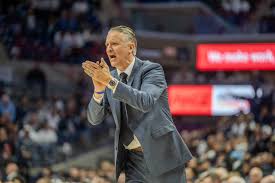
  • On a quiet weekday afternoon inside the Hazel Center, the sounds arrive before the scene comes into focus. Sneakers squeal against worn hardwood. Basketballs strike the glass with sharp, hollow echoes. Voices rise, overlap, and settle as drills rotate and players shift from one station to the next. At the center of it all stands Ted Hotaling, clipboard tucked under his arm, eyes locked on details most people never notice.

    Hotaling does not raise his voice. He rarely needs to. A short instruction, a quick demonstration, and a nod send players back into motion. Practice moves with purpose, shaped by repetition and clarity. The scene feels ordinary on the surface, yet it represents something extraordinary for the University of New Haven. This gym now houses a Division I basketball program, and Hotaling has guided every step of the climb.

    The move to Division I marked a defining moment for the Chargers, but the transition also reflected decades of preparation by a coach who never rushed the process. Hotaling’s journey to this moment began long before conference realignment, facility upgrades, or national attention entered the conversation.

    “My family was always sports-oriented,” Hotaling says. “I grew up at practice. That was just normal for us.”

    Hotaling’s parents shaped that environment. His mother, who grew up before Title IX expanded opportunities for women, brought a sharp understanding of athletics and coaching. His father played three sports in college and later coached at the high school level in upstate New York. Sports defined daily life in the Hotaling household.

    “I’ve been at practice every day since I was five years old,” Hotaling says. “Either I managed for my dad or I played. It was just the family business.”

    That constant exposure planted a foundation rooted in routine and responsibility. Coaching never felt abstract to Hotaling. Coaching felt familiar. Over time, familiarity turned into curiosity, and curiosity evolved into obsession. Hotaling studied how teams practiced, how coaches communicated, and how leadership shaped culture.

    That mindset followed him through each step of his coaching career. Hotaling worked under respected mentors, including Steve Clifford and James Jones, and treated every stop as a classroom.

    “You can learn from anyone if you pay attention,” Hotaling says. “You have to be open-minded and take pieces from different people, then make it your own.”

    Hotaling still keeps practice plans from every job he has held, stacked neatly inside his office with handwritten notes scribbled along the margins. Those pages capture drills, philosophies, and reminders about how players respond to instruction.

    “I’m very curious,” he says. “When you’re around good coaches who are willing to teach, it makes learning easy.”

    That approach eventually led Hotaling to the University of New Haven, where he inherited a Division II program and steadily built it with patience and consistency. Wins followed, but Hotaling focused on people before results. He prioritized culture, accountability, and development.

    Years later, when the university committed to a move to Division I, Hotaling faced the most demanding challenge of his career. The transition required rapid recruiting, expanded scheduling, and a complete roster overhaul in a matter of months.

    “I didn’t have time to sit back and process it,” Hotaling says. “We had to recruit, build a roster, and get ready to compete.”

    Hotaling intentionally took control of the roster construction. After an assistant coach departed for Yale, Hotaling decided to evaluate and recruit players himself.

    “I wanted to get the people part right before anything else,” Hotaling says. “I knew this would be hard. I wanted players who fit what we do and how we work.”

    He signed four Division II players and filled out the remaining roster through relentless outreach and evaluation. Long days turned into late nights, and the work continued without pause. Hotaling embraced the challenge.

    “It was actually enjoyable,” he says. “We added good people and good players.”

    The increased attention that comes with Division I has not altered Hotaling’s daily approach. Practices look the same. Expectations remain unchanged. Preparation drives everything.

    “Regardless of level, we all do the same job,” Hotaling says. “The awareness might change, but the work stays the same.”

    Athletic Director Devin Crosby believes that mindset positions New Haven for long-term success.

    “Ted Hotaling is a consummate Division I head coach,” Crosby says. “He understands the entrepreneurial nature of NCAA Division I athletics and the broader enterprise of higher education. He is an excellent recruiter, maintains strong relationships across the NCAA, and brings a high-level basketball mind.”

    Crosby sees Hotaling as the architect of New Haven’s future at the highest level.

    “Under Ted’s leadership, the University of New Haven will compete for NEC championships and position itself for NCAA tournament appearances,” Crosby says. “It is my responsibility to ensure Ted has every resource appropriate for our conference, and I take that seriously. We have something special, and Ted is leading the charge for our basketball program.”

    That belief resonates inside the locker room. Players respond to Hotaling’s clarity and consistency, especially during demanding practices that mirror game intensity.

    For Jabri Fitzpatrick, Hotaling’s impact shows up daily.

    “Ted is an amazing coach,” Fitzpatrick says. “Every day in practice, I see myself and my teammates understand what he teaches. Ted gives me complete confidence, both here and wherever basketball takes me. He always emphasizes taking care of what we need to do.”

    Fitzpatrick’s words reflect a program built on trust. Players know what Hotaling expects and why those standards matter. Confidence grows from preparation, not promises.

    Moments like hosting Penn State at the Hazel Center underscore how far the program has traveled. Power-conference teams rarely visit smaller gyms, yet New Haven welcomed national competition onto its home floor. The building felt packed, loud, and alive.

    Hotaling did not frame the moment as validation.

    “I just love coaching,” he says. “I love the work.”

    Former players filled the stands that night, reconnecting with a program that shaped their lives. Hotaling noticed them, appreciated them, and then returned his focus to the bench.

    “I’m happy for the university,” Hotaling says. “I’m happy people are paying attention.”

    The future will bring new challenges, larger expectations, and greater visibility. Hotaling does not dwell on legacy or recognition.

    “I’m just the caretaker of the program,” he says. “Someone will replace me someday.”

    When that day eventually arrives, Hotaling hopes people remember him simply.

    “I just want to be remembered as a basketball coach,” he says. “I love basketball. I love coaching. That’s enough for me.”

  • Aaron Glenn walked into this week’s press conference looking like a coach who’s fully locked in — not rattled, not defensive, just steady. And honestly, that might be exactly what the Jets need right now. Instead of dodging the tough questions, Glenn leaned into them, making it clear this team is still building something real, even if the results aren’t always showing it on Sundays.

    What stood out most was how direct he was about identity. Glenn isn’t interested in quick fixes or panic moves. He wants structure. He wants consistency. And he wants players who buy into that every single day. You could hear it in his voice — this isn’t just coach-speak. He believes the group is closer than people think.

    He also pointed to small but meaningful progress. The communication is cleaner. The effort is steadier. The wins may not be stacking up the way fans hoped, but he sees signs that the foundation is finally settling. And coming from a coach who’s never been shy about holding players accountable, that says something.

    When roster questions came up, Glenn shut down any idea of rash decisions. Moves will happen only if they push the team forward. Period. He wants growth, not noise.

    By the end, Glenn’s message landed: the Jets aren’t chasing shortcuts. They’re chasing a standard. And while the process can feel slow from the outside, Glenn sure sounds like a coach who knows exactly where he wants this team to go — and isn’t budging from that path.

  • Man — I’ve been thinking about Garrett Wilson a lot lately. As we all know, the guy has been sidelined with a nagging knee injury, and each passing week makes a return feel just a bit more urgent.

    Here’s where we stand right now: after aggravating that same right-knee sprain he initially suffered back in Week 6, Wilson was placed on injured reserve, which forces him to miss a minimum of four games. The Jets just wrapped up Week 14, which means — if all goes well — Wilson could be eligible to return in Week 15 when the team takes on the Jacksonville Jaguars.

    Of course, there are caveats. He needs medical clearance, and the team might decide it’s smarter to sit him out — especially since the season is already slipping away and risking a reinjury doesn’t make much sense.

    On the bright side? The head coach has expressed optimism that Garrett will still suit up in 2025. And if he comes back Week 15, even for a few games, it would feel like a small win for him — and for all of us hoping to see him back making plays.

  • For a franchise with the pedigree, market size and financial muscle of the New York Jets, the bar should be far higher than “maybe we’ll be interesting this year.” Yet under owner Woody Johnson, that has become the unofficial mission statement. Two decades into his stewardship, the Jets remain a team forever promising a new era, only to circle back to the same place: searching for direction, stability and an identity that isn’t built on dysfunction.

    Johnson isn’t a hands-off owner, nor is he a villain. He spends money. He invests in facilities. He desperately wants to win. But wanting to win and knowing how to build a winning culture are very different skill sets—and the gap between the two has defined the NY Jets of the modern era.

    The failures aren’t subtle. Since Johnson bought the team in 2000, the Jets have made the playoffs six times—and not once since 2010. That drought is now the longest in the NFL. Coaches and general managers come and go like tenants in a rental property. Promising seasons collapse under the weight of bad roster construction, poor quarterback development, and a carousel of “quick fixes” meant to shortcut the rebuild process.

    Johnson’s fingerprints have been on almost all of it. He was central in hiring Adam Gase, a move so baffling that many fans still treat it like a fever dream. He green-lit the rush to chase Aaron Rodgers, a splashy, expensive gamble that fits the Johnson era perfectly: big headline, big hope, and big risk with no contingency plan.

    To be fair, Johnson’s passion is genuine. His willingness to spend separates him from truly negligent owners. But the pattern under him is unmistakable—he tends to be attracted to star power, flash and the illusion of momentum rather than the slow, sometimes boring work of organizational patience. Where franchises like the Ravens or Steelers thrive through continuity and trust in long-term philosophy, the Jets repeatedly chase the next shiny solution.

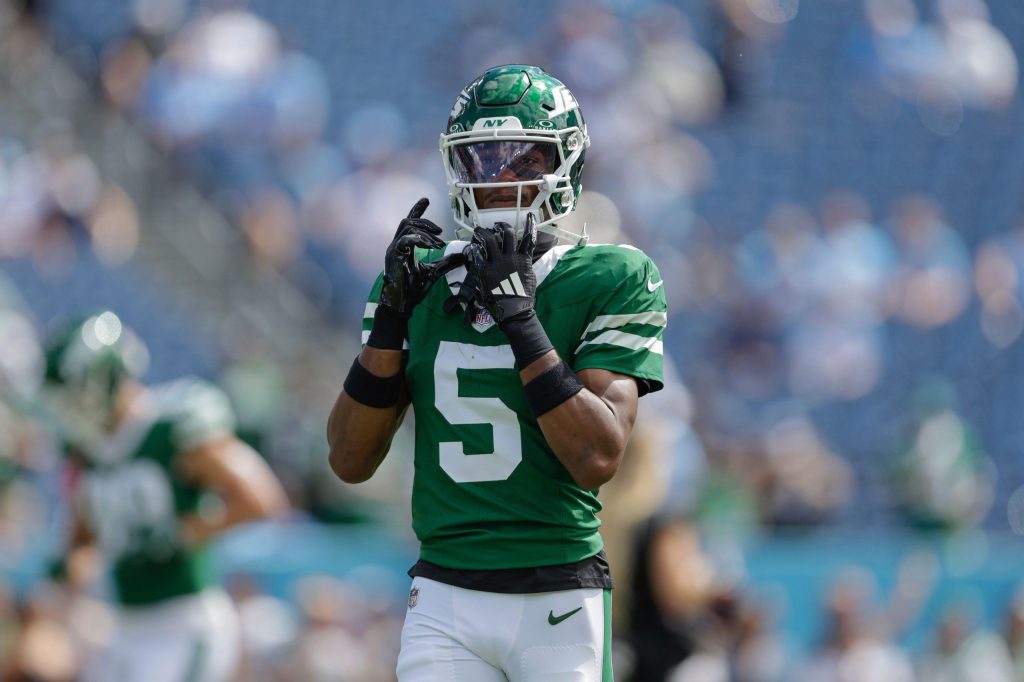
    This season, that tension is clearer than ever. The roster is talented. The defense is elite. Garrett Wilson and Breece Hall are foundation-level players any franchise would envy. Yet the Jets enter each offseason carrying the same Achilles’ heel: no consistent plan at quarterback, no clear direction in the front office, and no alignment from ownership down to the field.

    That’s where Johnson’s stewardship matters most. Culture starts at the top. Stability comes from the top. And accountability—true accountability—has to begin with the owner recognizing his own role in the cycle.

    The Jets don’t need Woody Johnson to sell the team. They need him to evolve. To hire the right football minds and actually let them work. To resist the splashy shortcut and commit to an identity built on development and continuity. To understand that long-term success isn’t a headline—it’s a foundation.

    Until that happens, Jets fans will keep doing what they’ve always done under Johnson: hoping for a breakthrough, bracing for the inevitable, and wondering when the owner will realize that the biggest fix the franchise needs might start with him.

  • What you need to know:

    The Jets and Falcons meet this weekend in a game that feels like a mirror staring back — two teams with talent, flashes of brilliance, and an unshakable habit of stepping on their own shoelaces. The Jets need this one like New York needs oxygen. The defense has carried the team long enough, and at some point, the offense has to show up with more than field goals and wishful thinking. If they can get competent quarterback play and avoid turning third downs into prayer sessions, they should control the tempo.

    Atlanta’s no cupcake, though. Bijan Robinson can change a game in one cut, and if the Jets don’t bottle him up early, they’ll be chasing all afternoon. But here’s my gut feeling — this is the type of ugly, grind-it-out matchup where the Jets defense thrives. If they force turnovers and steal a short field or two, they walk out with a win. Not pretty, but pretty doesn’t matter. Wins do.

  • I couldn’t believe it when Justin Fields revealed that being benched by New York Jets came as a total shock — “I did not anticipate it whatsoever,” he said.

    Despite the disappointment, Fields hasn’t lost his confidence. He insists he still sees himself as a legitimate starting-caliber quarterback in the NFL, whether that’s in New York or somewhere else down the road.

    He admits the first day after the benching hit hard — “it was tough,” he said. But rather than giving up, he’s using this setback as motivation.

    For now, he’s focusing only on the present — staying ready, working hard, and being prepared if and when opportunity knocks again. Because to him, this isn’t the end — just a detour on the journey.

  • I tuned into Aaron Glenn’s press conference like most Jets fans — coffee in hand, expectations low, hope slightly alive but on life support. And honestly? Glenn was… refreshing. Not like-win-the-division refreshing, but more like finally someone admits what we’re all watching refreshing. He didn’t sugarcoat 2–9. He didn’t sell playoff fantasies. He basically looked into the camera and said, “We’re not good yet — but we’re growing.” And weirdly, I bought it.

    He talked up the rookies, praised the hustle, even acknowledged the pain we all feel every Sunday. You could tell he sees development where fans see chaos, and maybe that’s what makes him the adult in the room. Glenn didn’t promise miracles — just effort, discipline, and hopefully fewer interceptions than existential crises.

    And for once, instead of screaming at my TV, I nodded. Maybe we’re not winning games yet, but we might be building something. Step one: survive Sundays. Step two: progress.